Why Standard-Issue PPE Fails Your Workforce and What to Do About It
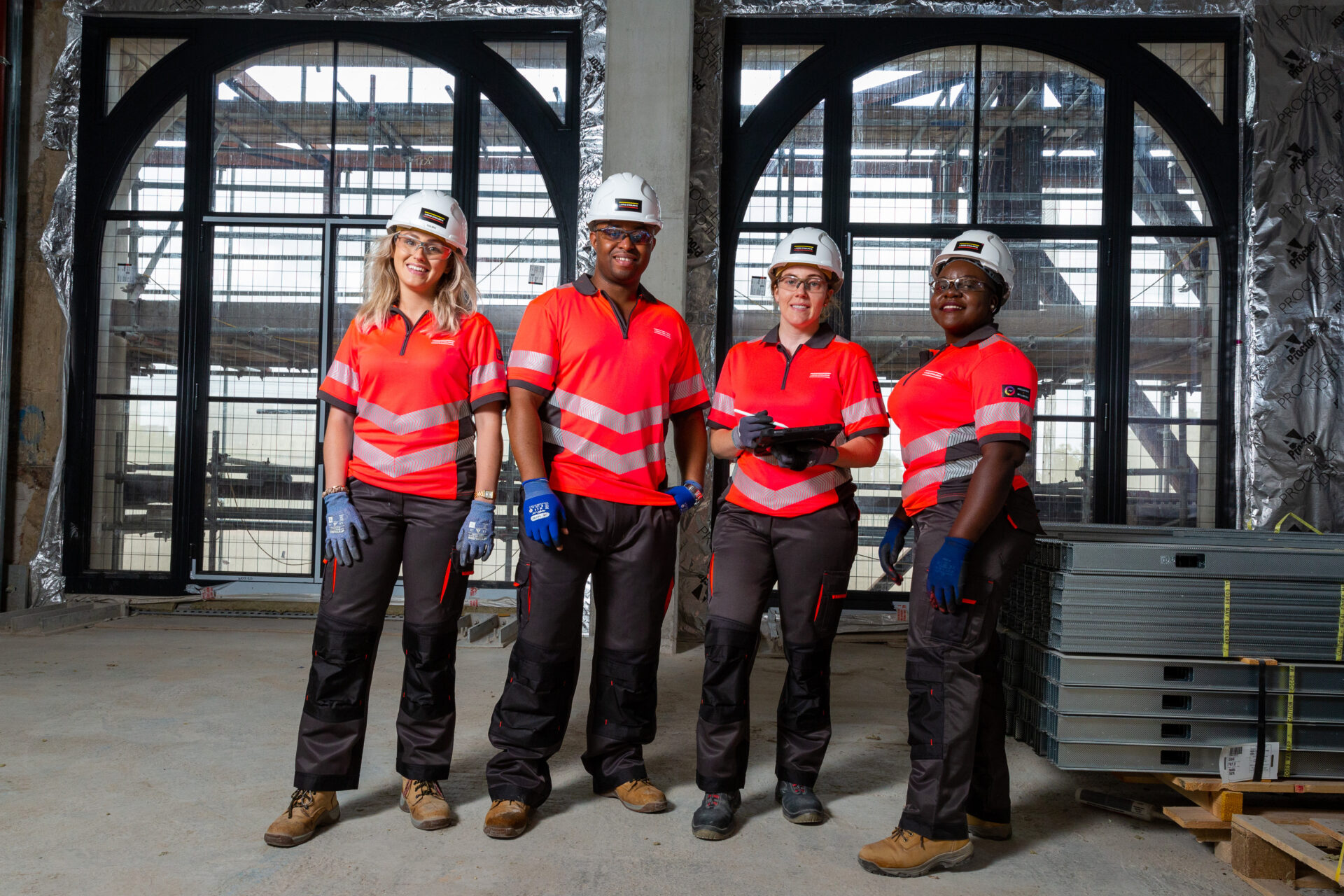
A garment may pass procurement checks yet fail when a worker climbs into a vehicle, kneels beside equipment or wears it through a long shift. Understanding why ‘Standard Issue’ PPE is failing your workforce requires organisations to examine fit, usability and lifecycle performance, not simply certification and unit cost. As a B Corp certified business, we connect workforce productivity with inclusive design, responsible sourcing and reliable uniform management — because, as we say, no-one is uniform.
Standard PPE Is Not Designed for Real-World Work
Standard PPE is not designed for real-world work because a single pattern cannot fit every body, role or task it is issued to cover. Issuing identical PPE uniforms across varied roles may simplify purchasing, but it transfers cost and risk into operations across construction, utilities and transport alike. In a study of construction workers, 40.6% of workers did not use PPE at all during work, and among those non-users, 69.2% cited poor fit or PPE falling off as a reason for not using it, behind only discomfort and a lack of knowledge on correct use.
PPE should operate as a connected system covering garment design, wearer engagement, stock, care and replacement. Our principles of being inclusively designed for wearer wellbeing and sustainable by design connect gender-inclusive design with safety, productivity and compliance.
One Size Does Not Fit a Diverse Workforce
Gender-inclusive design in PPE means offering fits, cuts and size ranges built around different body types and needs, rather than scaling a single pattern up or down and calling it unisex. Safe PPE starts with the wearer. Height, body shape, proportions, disability, pregnancy, required layers and job activity all influence fit, comfort and freedom of movement. Designing around the needs of a diverse workforce helps improve compliance, wearer wellbeing and day-to-day performance, and this applies as much to construction uniforms doubling as PPE as it does to warehouse or laboratory wear.
Size labels describe measurements, not suitability for an individual or task. Our Green Thread Sustainability perspective reinforces an important connection: garments that fit more people correctly are less likely to be rejected, exchanged or replaced prematurely.
The Cost of Treating PPE as a Commodity
Treating PPE as a commodity costs more than it saves, because the true cost of PPE extends well beyond the purchase price. As the Chartered Institute of Procurement and Supply’s guidance on total cost of ownership sets out, buyers need to look at the end-to-end cost of a purchase rather than the price paid alone, and PPE is no exception. Applied to a uniform programme, that means weighing the purchase price against acquisition costs such as fitting and delivery, usage costs such as laundering and repair, and end-of-life costs such as disposal or recycling, not just the invoice for the garment itself. Procurement teams should consider garment lifespan, wearer acceptance, stock management, replacements, exchanges, laundering, repairs and end-of-use disposal together. Well-designed PPE uniforms that people are comfortable wearing are more likely to remain in use for longer, reducing unnecessary replacement and supporting more efficient programme management.
An experienced PPE uniform supplier adds value through more than product supply. Inclusive fit, wearer engagement, reliable stock availability, consistent quality and long-term managed service all contribute to smoother operations and better value over the lifetime of a uniform programme. Focusing on purchase price alone can create hidden operational costs through poor wearer adoption, higher replacement rates, inconsistent stock and avoidable disruption.
How Poor Fit Undermines Safety and Compliance
Personal protective equipment can only perform as intended when it fits the wearer correctly. Garments that are too loose may snag or interfere with equipment, while those that are too tight can restrict movement, reduce comfort and make physically demanding tasks more difficult. Poor fit can also discourage consistent wear, increasing the risk that PPE is used incorrectly, altered or removed altogether — even when the item itself meets the relevant technical standard. Certification confirms a garment meets a defined technical standard; it does not confirm the garment suits the individual wearer or the task they are doing, and treating the two as interchangeable is where many PPE programmes go wrong.
Designing PPE around female body shapes, rather than adapting men’s patterns, is one of the clearest ways to close that gap in safety-critical roles. When Laing O’Rourke wanted to encourage more women into construction, we ran six wearer trials across multiple sites with over fifty participants to develop a PPE range designed specifically for women rather than a modified version of men’s workwear — the kind of wearer-led process that turns a compliant garment into one genuinely suitable for the wearer and the work.
The UK Health and Safety Executive advises employers to select PPE that suits the worker, taking account of size, fit, compatibility and the physical characteristics of the individual. Designing PPE around a diverse workforce, rather than relying on standard sizing, helps improve wearer wellbeing, supports consistent compliance and enables people to carry out their roles safely and comfortably in construction uniforms, utility company uniforms and transport workwear alike.
HSE guidance treats PPE as the last resort in a hierarchy of controls, behind elimination, substitution, engineering and administrative controls. A risk assessment is used to decide whether PPE is needed at all before fit, comfort or garment specification are even considered — which is why PPE selected without wearer input so often fails once it reaches the workplace.
Restricted Movement Creates Everyday Risk
Restricted movement creates everyday risk because workers must climb access points, enter vehicles, kneel, handle tools and reach overhead without exposing themselves to avoidable hazards. In construction uniforms and PPE alike, poorly placed seams, excess fabric or insufficient articulation can turn routine movement into a repeated hazard, and the same is true of transport workwear worn in cabs, platforms and yards.
Stretch panels, shaped knees and carefully positioned seams can support mobility without weakening protected areas. Specifications must also consider changing weather and the combined bulk of every layer worn beneath an outer garment.
Comfort Drives Wearer Adoption
Comfort drives wearer adoption because uncomfortable PPE gets left in a locker or loosened on the job, however protective it is on paper. Thermal discomfort caused by personal protective equipment can increase heat stress, particularly during long shifts and in high temperatures or humidity. HSE’s own guidance on heat stress names work clothing and PPE directly as a factor that can prevent sweating and other ways the body regulates its temperature. This is one reason why ‘Standard Issue’ PPE is failing your workforce: poorly fitted, non-breathable PPE uniforms can undermine wearer wellbeing, concentration, and safe performance. Breathability, moisture management and freedom of movement should be assessed together as one thermal comfort package, not specified separately. Thermal comfort should be treated as a core safety control, not an optional employee benefit.
Organisations can measure adoption through realistic wearer trials, worker feedback, non-compliance observations and replacement records. This evidence distinguishes isolated preferences from recurring design problems that affect whole wearer groups. In our own wearer trials for Great Western Railway, a sizing roadshow and structured wearer feedback process — not a lab test of the fabric alone — surfaced a cold-platform comfort issue that a zip-in coat lining was specifically added to solve, illustrating how thermal comfort problems tend to surface only once real wearers are involved.
The Hidden Operational Impact of Poor PPE Design
Ill-fitting or unreliable garments can slow task completion, damage morale and weaken confidence in an employer’s duty of care. Inconsistent availability also forces supervisors to delay work or approve unsuitable substitutions, especially across dispersed utilities, construction and transport teams.
Standards such as EN ISO 13688 address general protective-clothing requirements, including ergonomics and sizing, but operational suitability still requires workplace evaluation. A coherent uniform programme also protects brand consistency when uniformed employees work around customers, passengers or the public.
Durability Is About Performance Over the Garment Life
Durability means retaining protective function and usable condition through wear, care and laundering, not merely surviving an initial wearer trial. Assessment should cover abrasion resistance, seam strength, fastenings, colour retention and compatibility with prescribed washing processes.
A PPE inspection checklist should distinguish normal wear from damage that may compromise protection. Clear care instructions and prompt withdrawal rules prevent workers from continuing to use garments whose seams, closures or protective materials have failed.
Poor Stock Management Produces Poor Issue
Poor stock management produces poor issue because incomplete size curves, inaccurate wearer records and disconnected ordering systems create shortages in exactly the garments people need. Excess stock in unsuitable sizes does not compensate for a missing size at the point of issue.
Forecasting should reflect role, location, season, starter volumes and historical replacement patterns. This approach gives operations reliable availability while helping finance avoid unnecessary inventory and emergency purchasing.
Build an Inclusive, Task-Led PPE Programme
A hazard assessment is a structured review of the risks a role actually faces, covering physical, chemical, environmental and ergonomic factors, used to decide what protection a garment must provide before any fabric or fit decision is made. An effective programme begins with this kind of hazard assessment and job observation, then evaluates protection, fit, comfort and usability together. A structured fit assessment should include representative body types, roles, sites and shift patterns before specifications are finalised, across construction uniforms, factory workwear and transport uniforms alike.
Fit testing should be a documented part of this assessment, using representative workers to check garment security, movement, visibility, compatibility with other equipment and comfort during realistic tasks. Repeating fit testing after design, sizing or layering changes helps confirm that PPE remains suitable across roles and working conditions.
Inclusive uniforms are a practical response to workforce diversity, not a cosmetic initiative or a special request managed after launch. Early wearer participation exposes design conflicts before they become costly stock, compliance or productivity problems.
Start With Work, Wearers and Conditions
Starting with work, wearers and conditions means mapping each role’s hazards, movement patterns, environmental exposure, equipment interfaces and required layers before any fabric or fit decision is made. This analysis prevents a technically compliant garment from obstructing a harness, tool belt, radio or vehicle restraint.
Wear trials should reproduce realistic conditions and use consistent criteria for movement, access, comfort, fit and perceived protection. Structured feedback produces better evidence than asking wearers whether they simply like a garment.
Design for Inclusive Fit and Layering
A considered size range may require alternative fits, lengths and adjustable features rather than one pattern enlarged in every direction. Adjustment must improve security and comfort without introducing loose components or unnecessary issue complexity.
Base layers, mid-layers, outerwear and accessories should function as one protective system, assessed together rather than specified in isolation. A base layer’s job is moisture management next to the skin, checked for wicking and breathability; a mid layer adds insulation without extra bulk, checked for its warmth-to-weight ratio; an outer layer provides weather and hazard protection, checked for durability, protective rating and freedom of movement. Seasonal layering fails when added bulk restricts movement, hides visibility features or prevents closures from working correctly.
Make Sustainable Workwear Part of Safety Performance
Sustainable workwear should prioritise long service life, repairability, responsible material choices and planned end-of-life routes without compromising protection. Ethical workwear also requires traceable sourcing and credible labour standards rather than unsupported environmental claims.
Our principle of durability, repairability, and responsible sourcing as standard links sustainability with lower operational disruption. Effective rollout planning ensures these design intentions survive procurement, garment issue, care and eventual replacement.
Regulatory pressure on this data is building. Under the EU’s Ecodesign for Sustainable Products Regulation (ESPR), a Digital Product Passport for textiles is expected via a delegated act around 2027, with compliance anticipated from 2028 onward. UK PPE and workwear programmes supplying into the EU should start capturing durability, repairability and material-origin data now, rather than waiting for the legislation to land.
Design for Repair, Care and Replacement
Organisations should identify repairable components and define processes for inspection, laundering, authorised repair, PPE replacement and withdrawal from service. Repair can extend garment life, but damaged PPE must be replaced whenever its protective performance may have been affected.
Care guidance should be specific enough for wearers, laundries and supervisors to follow consistently. Uncontrolled washing or unauthorised alterations may shorten service life or damage protective properties.
Use Lifecycle Data to Improve Future Decisions
Lifecycle data improves future decisions when organisations track issue volumes, repairs, returns, damage causes, wearer comments and replacement frequency by garment, role and location. Lifecycle data reveals whether failure stems from design, sizing, care, working conditions or poor stock allocation.
Teams can use these findings to refine specifications, stock profiles and budget forecasts at the next review. Evidence-led lifecycle management makes safety performance and expenditure more predictable.
Avoid the Most Common PPE Programme Mistakes
Selecting on unit price alone, assuming certification guarantees usability and testing with a small, unrepresentative group all create avoidable risk. Women’s fit, adaptive requirements and inclusive sizing must form part of the initial specification rather than exceptions handled after rollout.
Garment design should not be separated from ordering, repairs, replacement and wearer communication. A technically strong garment can still fail operationally when employees cannot obtain, exchange or maintain it correctly.
Plan Rollout as an Operational Change
Rollout succeeds as an operational change when procurement, operations, health and safety, HR and site leadership have defined responsibilities before launch, not afterwards. Shared ownership prevents fit concerns, stock shortages and compliance issues from falling between departments.
Where appropriate, organisations should phase delivery, validate size data and establish straightforward exchange routes. Workers also need practical guidance on correct fit, garment care and how to report damage without delaying replacement.
Frequently Asked Questions
Why Does PPE Fit Matter?
PPE must fit the wearer and the task. Poor fit can restrict movement, create snagging hazards, interfere with other equipment and make consistent wear less likely.
What Should Workers Do If PPE Is Damaged?
Workers should stop using PPE when damage could affect its protective function, report it through the agreed process and obtain a suitable replacement. Inspection and care guidance should explain who assesses damage and how replacement is authorised.
What Should Businesses Look for in a Sustainable PPE Supplier?
Look for inclusive fit, durable construction, representative wearer trials, responsible sourcing and long-term programme management. Sustainable PPE should reduce waste and support employee wellbeing without compromising protection or compliance.
How Can Custom PPE Improve Safety and Workforce Performance?
Custom PPE reflects real body shapes, working movements and equipment interfaces, improving fit, comfort and mobility. Better usability supports consistent wear, reduces avoidable garment replacement and protects workforce productivity.
How Can Employers Make PPE More Inclusive?
Employers should conduct representative wearer trials, provide considered fits and sizes, and assess real tasks and layering requirements to support worker compliance. Simple exchange processes are equally important when an issued garment does not fit safely.
What Standard Governs General Protective Clothing Requirements?
EN ISO 13688 sets the general requirements for protective clothing, covering ergonomics, sizing, ageing, compatibility and manufacturer marking. It is a base standard used alongside hazard-specific standards, not a replacement for them, so a garment can meet EN ISO 13688 and still need separate certification for the specific hazard it is designed to protect against.
What Should a PPE Inspection Checklist Cover?
A PPE inspection checklist should separate normal wear from damage that could compromise protection, covering seams, fastenings, colour retention and compatibility with prescribed washing. It should set clear withdrawal rules so garments with failed protective materials are taken out of service immediately rather than left in circulation until the next scheduled review.
What Is PPE Lifecycle Management?
PPE lifecycle management is the ongoing tracking of a garment’s issue, repair, laundering, replacement and end-of-life across its working life, not just its initial purchase. It uses data on damage causes, replacement frequency and wearer feedback to catch design or stock problems early, so a programme improves over time instead of repeating the same avoidable failures.
A Better PPE Standard Starts With the Wearer
Effective PPE is protective, wearable, inclusive, durable and available when required. For organisations with large, distributed workforces across construction, utilities and transport, those outcomes depend on continual stock, fit and lifecycle management rather than a one-off garment purchase.
Our 45 years experience across complex workforce clothing programmes, including construction uniforms, shows why wearer wellbeing must be balanced with operational performance, brand identity and long-term cost. The strongest PPE standard is not the garment that looks compliant on a specification sheet, but the complete system that protects people reliably throughout real work.
If you want to pressure-test your own PPE programme against fit, sourcing and lifecycle management, get in touch with our team.
More Articles

Is Your Hotel Uniform Ready for the EU’s New Sustainability Rules? A Guide to Sustainable Hotel Uniforms
Hotel uniforms are ready for new EU sustainability rules when each garment is backed by product-level data on fibre composition, sourcing, durability and end-of-use, so hotel groups that build this evidence now will be best placed as CSRD, ESPR and the Digital Product Passport take effect. A hotel uniform contract may look operational, but it […]

Can Better Uniforms Improve Hospitality Staff Retention? The Role of Hospitality Uniforms in Employee Experience
Better hospitality uniforms can support staff retention by removing a daily source of friction, although pay, progression, management and workload also shape labour turnover. A hotel employee may spend an entire shift adjusting a restrictive waistband, coping with excess heat or working without the pockets needed for basic tasks. That makes the question “Can Better […]

Do Your Guests Judge Your Brand Before They Reach the Front Desk? How Hotel Uniforms Shape First Impressions
The Guest Experience Starts Before Reception The guest experience starts at the kerb, the entrance or the first staff interaction, well before check-in. Every step of the arrival sequence shapes brand perception before a guest reaches the front desk, and hotel uniforms are one of the most visible parts of that sequence. Guests start forming […]

What Does a Uniform Programme Say About a Retailer’s Sustainability Commitments?
A Uniform Programme Is Evidence of How a Retailer Operates A uniform programme shows whether a retailer’s sustainability commitments work in practice or exist only as policy. When stores span several regions, uniforms become a recurring test of whether corporate sustainability policies work in everyday operations. Judging that means looking beyond sustainable uniforms to the […]
How Do Multi-Site Retailers Keep Retail Uniform Standards Consistent Across Every Location?
Why Uniform Consistency Is an Operational Standard Multi-site retailers keep retail uniforms consistent by treating them as an operational standard, because a garment is only as consistent as the ordering, stock and quality processes behind it. A retail uniform may look consistent at launch, yet differences soon emerge between stores, roles and regions. The practical […]

Why Retail Teams Outgrow Off-the-Shelf Uniforms
When Off-the-Shelf Uniforms Stop Supporting Growth Catalogue garments offer a practical, low-commitment starting point when a retailer has a small team and straightforward requirements. Retail teams usually outgrow off-the-shelf uniforms because operational complexity increases, not because ready-made clothing is inherently the wrong choice. More stores, territories, roles, seasonal peaks and wearer needs turn simple purchasing […]
