How Do Multi-Site Retailers Keep Retail Uniform Standards Consistent Across Every Location?
Why Uniform Consistency Is an Operational Standard
Multi-site retailers keep retail uniforms consistent by treating them as an operational standard, because a garment is only as consistent as the ordering, stock and quality processes behind it. A retail uniform may look consistent at launch, yet differences soon emerge between stores, roles and regions. The practical answer to “How Do Multi-Site Retailers Keep Uniform Standards Consistent?” lies in controlling the entire uniform programme, not merely approving an initial design.
Company uniforms express brand guidelines, build customer confidence and give employees a shared sense of belonging. A managed uniform programme must provide every wearer with approved garments in the correct size and at the appropriate point in their employment journey, supported by a clear service-level agreement with uniform suppliers, the document that turns “the supplier should be reliable” into specific, checkable commitments on delivery times, fill rates and defect resolution.
The Cost of a Patchwork Uniform Experience
Visual consistency deteriorates when stores use substitutes, delay replenishment or retain visibly worn garments. The damage compounds because each individual substitution looks minor while the cumulative effect across dozens of stores does not. Differences in fit, garment condition, colour matching and local ordering can create extra administration while weakening brand consistency.
This matters particularly in beauty, premium retail and service-led settings, where customers rely on presentation to identify employees and understand their roles. We apply 45 years experience to complex retail programmes, and our B Corp certified status gives us a wider framework for considering people and environmental impact.
Set One Clear Standard Before Scaling the Programme
A uniform specification is the controlled document that records every approved garment, colour, fabric, trim, branding position, care requirement and replacement rule. The uniform supplier and retailer should treat it as an operational document, requiring formal approval before any design, material or production change.
The specification must distinguish fixed brand elements from authorised adaptations for climate, legislation, store format and role. This controlled approach supports our ‘sustainable by design’ principle by considering longevity, practicality and lifecycle requirements before scaling production. Our wider commitments are set out in our Green Thread Sustainability programme.
Build a Cohesive Range for Different Retail Roles
A cohesive range gives each role a suitable garment while holding one shared identity. Front-of-house employees, managers, stockroom teams, beauty consultants and delivery-facing staff may require different garments, and forcing all of them into one silhouette usually fails somebody. Shared colours, logo treatments and styling principles can preserve one recognisable identity without forcing everybody into an unsuitable design.
Role mapping, which assigns each job its approved garments, also improves stock forecasting because demand can be calculated against actual workforce profiles and garment entitlements.
Choose Fabrics for Real Store Conditions
Fabric durability, colour retention, easy care and repairability protect a professional appearance throughout the garment lifecycle. For active roles, stretch fabric can make the difference between clothing that restricts movement and clothing that follows the wearer during replenishment, demonstrations and long shifts. Stretch fabric is cloth that extends with the wearer’s movement and recovers its shape afterwards.
Fit should be assessed as carefully as fabric selection. Both sources below cover protective clothing rather than everyday retail wear, but the principle carries over to any garment worn all day. EU-OSHA guidance on reflective protective clothing says a garment should fit properly, being neither too loose nor too tight, so that it does not impair movement, and the UK Health and Safety Executive tells employers choosing personal protective equipment to consider the size, fit and physical characteristics of the wearer.
Design for Inclusive Fit and Wearer Wellbeing
Inclusive sizing is a size range designed to fit different body shapes, not just a standard range with extra sizes added at either end. Appropriate garment blocks, consistent grading and validation across different body shapes help employees achieve a comparable fit and appearance. A garment block is the base pattern a style is developed from, and grading is the method of scaling that pattern up and down the size range.
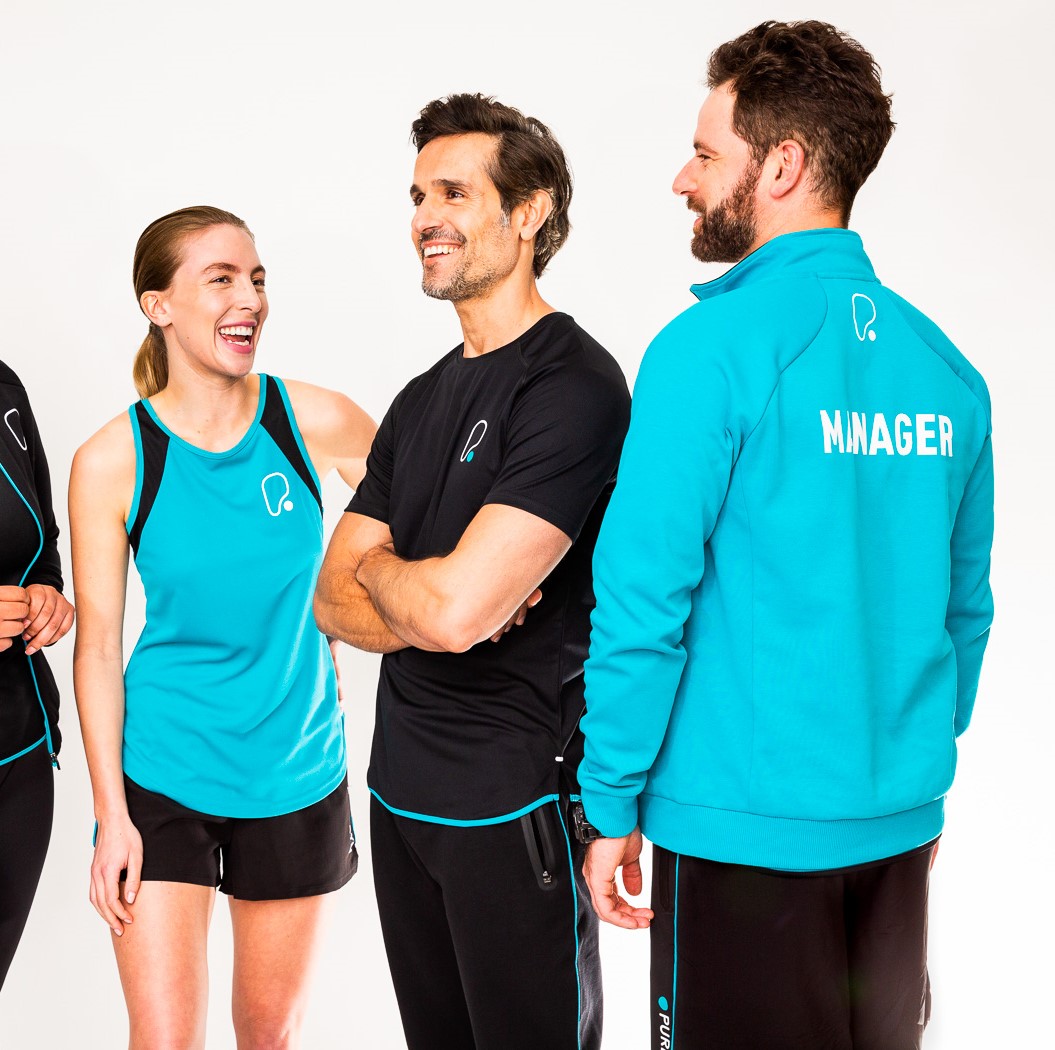
For PureGym, we took time to understand wearer size profiles in every job role, kept the garments gender neutral so that everyone could choose the look that suited them, and included custom sizing, such as a longer arm or leg measurement, where necessary.
Our principle of ‘inclusively designed for wearer wellbeing’ connects fit with comfort, confidence and staff acceptance, and it starts from our belief that no-one is uniform. Retailers should also define maternity options, modesty requirements, layering and reasonable adjustments centrally, preventing managers from creating inconsistent local alternatives.
Use Wearer Trials to Identify Issues Early
A wearer trial is a structured test in which employees wear sample garments in live working conditions and report on fit, comfort and durability. Our research starts before design, with interviews and observations of end-wearers and interviews with stakeholders. We then make our trial samples in the final fabrics and trims, so the trial tests what will actually be issued. Structured wearer trials should include representative employees from different roles, regions, body shapes and working patterns. Fit testing in live stores can expose problems involving mobility, temperature comfort, laundering, pocket position or inconsistent sizing before full production.
On the PureGym project, we filmed sample fit sessions and shared them with the client team, so employees who could not attend, including those working from home, could still view and comment on the designs.
Feedback needs measurable criteria, such as range of movement, dimensional stability and garment condition after specified wash cycles. Design teams can then resolve recurring issues before a large-scale rollout makes changes costly and disruptive.
Centralise Entitlements, Ordering and Product Control
Role-based wearer entitlements are the rules that define each employee’s initial issue, replacement allowance, seasonal garments and optional items, so two employees in the same role receive the same retail uniform regardless of which store they work in. A centralised catalogue is the approved list of products, sizes and branding variants, and it limits every store to ordering from that list.
An online ordering portal can apply permissions, approval workflows and cost-centre rules while giving managers a straightforward ordering route. Central control reduces incorrect orders without removing visibility or accountability from local teams.
Make New Starter Onboarding Repeatable
Uniform allocation should connect with onboarding data so employees receive suitable garments before their first customer-facing shift, rather than starting a job in whatever the store happens to have spare. The process needs the wearer’s role, location, size, delivery point and start date, plus an escalation route for urgent appointments.
Prevent Unauthorised Local Variation
Access controls can restrict products by role, country or territory while recording exceptions centrally. This matters because an undocumented exception tends to become an assumed local standard over time. Legitimate local needs, including climate adaptations and country-specific labelling, should follow a defined approval process rather than independent store sourcing.
This preserves operational flexibility without introducing unapproved colours, fabrics or logo applications.
Plan Stock and Distribution Around Retail Reality
Retail uniform forecasts should combine employee numbers, recruitment plans, staff turnover, size curves (the expected spread of demand across each size), replacement rates, promotional peaks and planned store openings. Accurate stock visibility by product, size, territory and location helps identify shortages before they affect customer-facing teams. Replenishment is the planned resupply of approved garments before a store runs short.
Distribution planning must cover routine deliveries, urgent replacements and launch deadlines. Central stockholding can provide control, but routes and service levels should reflect real delivery conditions across UK and European locations. We have designed, manufactured and distributed bespoke beauty uniforms for over four decades, to wearers across the globe. We manage shipping, storage and distribution, whether in bulk to a retailer’s hubs or directly to individual wearers. Garments made outside the UK or the client’s domestic market go to dedicated warehouses, where they are audited after customs clearance and stored in areas set up for that client. Stock is barcoded and double-checked, and orders are tracked through an online system.
Control Availability Across Borders and Store Formats
International programmes must account for different lead times, customs processes, seasonal demand and local delivery constraints. Common core garments simplify planning, while approved regional variants can address climate or legal requirements without disrupting the overall visual standard.
Measure Fulfilment, Not Just Orders
Order volumes reveal demand but not whether employees received what they needed. An order count on its own is therefore a weak indicator of programme health. Performance reporting should track on-time, in-full delivery, back orders, size availability, repair turnaround, unresolved queries and returns management. On-time, in-full delivery is the share of orders that arrive by the promised date with every item and size ordered.
These measures turn retail uniforms from a reactive purchasing category into a measurable operational service.
Protect Standards Through Quality Control and Lifecycle Management
Quality control should operate at pre-production, production and dispatch stages, checking fabric, construction, sizing, branding and packing against the approved specification. A defect is then caught before it reaches a store rather than after a customer notices it. Product management also needs clear acceptance criteria and corrective actions for defects, shade variation and recurring fit concerns. Colour matching, the process of checking each production batch against an approved shade standard, is what stops a garment reordered next year looking different from the one issued today.
Our approach places durability, repairability, and responsible sourcing as standard. Combining responsible sourcing with controlled repair, return and reissue routes protects presentation while managing cost and material use. Reissue means passing a returned garment that is still serviceable to another wearer.
Extend Garment Life Without Lowering Presentation Standards
A repair is appropriate when it restores function and appearance without compromising fit or brand presentation. Replacement is preferable when fading, permanent staining, fabric damage or repeated repairs leave a garment visibly below standard.
Durable construction and repairability can reduce total cost of ownership by extending useful life. Total cost of ownership is the full cost of a garment over its working life, including purchase, replacement, repair, distribution and administration, not just the unit price. The decision must still protect the consistent customer experience expected across the estate.
Maintain Traceability for Future Requirements
Product-level records can capture materials, manufacturing origin, care information and lifecycle status. This data strengthens procurement assurance, environmental accountability and preparation for relevant EU Digital Product Passport requirements.
The Digital Product Passport is a digital record of product information, such as materials, origin, repairability and recycling, created under the EU’s Ecodesign for Sustainable Products Regulation for products placed on the EU market. A data carrier such as a QR code links each product to its passport, and the Commission says the EU registry where passports are registered went live on 20 July 2026.
The European Commission’s indicative timeline expects the delegated act covering textiles to be adopted in the second half of 2027, followed by a transition period of at least 18 months. The requirements are therefore not yet in force, and if that timeline holds they would not apply before 2029. Whether they will reach workwear depends on the final scope, so we treat this as preparation rather than a current obligation.
The practical preparation is the product-level record described above: materials, manufacturing origin, care information and lifecycle status for each garment, held in one place and linked to the stock record so the data can be handed over if it is required. Retailers can ask their uniform suppliers now whether they can provide it.
Create Governance That Keeps Every Location Aligned
Responsibility should be explicit across procurement, operations, brand, human resources and store leadership, with one accountable programme owner. On our side, each client has a dedicated account manager as its main contact. That way, when something goes wrong, there is a named person to escalate to rather than a committee to convene. Regular reviews should examine service performance, stock health, quality findings, wearer feedback and upcoming business changes.
A controlled communications plan must explain policy, garment care, ordering responsibilities and escalation routes to store teams. Our experience as leaders in Automotive, Hospitality, Transport, Travel, Retail, Services and Utilities demonstrates why cross-functional governance matters in complex wearer environments.
Use Reporting to Improve the Programme
A concise monthly dashboard should cover expenditure, fulfilment, stock availability, returns, repairs and compliance exceptions. It should be built so a regional manager and a group finance director can read the same numbers without needing a separate translation. Segmenting results by country, store group and role helps leaders distinguish a local process failure from a programme-wide problem.
Trend analysis can reveal persistent size shortages, unusually high replacement demand or stores using urgent delivery too frequently. Teams can then address root causes instead of repeatedly treating individual orders.
Avoid the Common Causes of Inconsistent Retail Uniforms
Retailers often treat uniform design as a one-off creative project while overlooking ordering, replenishment, repair and governance. Narrow sizing, limited wearer testing and fabrics unsuited to active work can undermine even a visually strong concept.
Fragmented purchasing introduces variation in colour, quality, fit and branding. Judging proposals by unit price alone can also conceal lifecycle costs associated with premature replacement, unreliable fulfilment and excessive administration.
Consistency requires full-service support for effortless uniform management, from design and sourcing to repair. That is how our process is built, running from research and design through development and manufacture to roll out, logistics and distribution. Every process must reinforce the approved standard rather than leave individual stores to solve recurring problems independently.
A Practical Standard for Multinational Retailers
Uniform consistency comes from combining a coherent design system with disciplined data, stock, distribution and service management. Our experience with complex retail clients such as Dufry, PureGym, Coventry Building Society and Pizza Hut, and our bespoke beauty uniforms for brands including Gucci Beauty and Liz Earle, shows that design, inclusive fit, stretch, lifecycle management and wearer wellbeing must function together at scale.
The strongest programmes accommodate different roles, markets and store formats without losing their shared identity. They give leaders measurable control while ensuring each employee receives suitable garments at the right time. If you are reviewing retail uniforms across several sites, you can talk to our London design studio about how we would approach it.
Frequently Asked Questions
What Should Retailers Look for When Choosing a Uniform Supplier?
Retailers should look for uniform suppliers with experience of complex multi-site programmes, custom design, inclusive sizing, production reliability and quality control. They should also examine forecasting, online ordering, distribution and long-term managed service capabilities, and ask how service levels are measured and reported.
How Do Multi-Site Retailers Keep Staff Uniforms Consistent Across Every Store?
Multi-site retailers keep staff uniforms consistent through central specifications, controlled catalogues, role-based entitlements, stock visibility and formal quality checks. A managed retail uniform programme then coordinates ordering, replenishment and distribution across every location, so each store issues the same approved garments.
What Makes a Good Uniform for Retail and Beauty Staff?
Effective retail uniforms combine clear brand presentation with comfort, suitable fit and practical performance. Stretch, breathability, fabric durability and inclusive sizing help garments support active work while maintaining a consistent appearance, and wearer trials in live stores confirm this before full production.
Can a Uniform Supplier Manage Uniforms for Multiple Retail Locations?
Yes, an experienced uniform supplier can coordinate stockholding, forecasting, ordering, entitlements, new starters, replenishment, returns, repairs, reissue and distribution. Central reporting gives decision-makers greater control while reducing the administrative burden placed on individual stores, and a dedicated account manager gives the retailer a single point of contact.
What Is the Difference Between a Centralised Catalogue and an Online Ordering Portal?
A centralised catalogue is the fixed list of garments, sizes and branding variants a store is allowed to order. An online ordering portal is the system managers use to place those orders, subject to permissions, approval workflows and cost-centre rules. The catalogue sets what is allowed, and the portal controls who can order it and how.
Will the EU Digital Product Passport Apply to Retail Uniforms?
Not yet. The European Commission’s indicative timeline expects the textiles requirements under the EU’s Ecodesign for Sustainable Products Regulation to be adopted in the second half of 2027, followed by a transition period of at least 18 months. Whether workwear falls within the final scope has not been confirmed, so retailers should keep product-level records now.
More Articles

Is Your Hotel Uniform Ready for the EU’s New Sustainability Rules? A Guide to Sustainable Hotel Uniforms
Hotel uniforms are ready for new EU sustainability rules when each garment is backed by product-level data on fibre composition, sourcing, durability and end-of-use, so hotel groups that build this evidence now will be best placed as CSRD, ESPR and the Digital Product Passport take effect. A hotel uniform contract may look operational, but it […]

Can Better Uniforms Improve Hospitality Staff Retention? The Role of Hospitality Uniforms in Employee Experience
Better hospitality uniforms can support staff retention by removing a daily source of friction, although pay, progression, management and workload also shape labour turnover. A hotel employee may spend an entire shift adjusting a restrictive waistband, coping with excess heat or working without the pockets needed for basic tasks. That makes the question “Can Better […]

Do Your Guests Judge Your Brand Before They Reach the Front Desk? How Hotel Uniforms Shape First Impressions
The Guest Experience Starts Before Reception The guest experience starts at the kerb, the entrance or the first staff interaction, well before check-in. Every step of the arrival sequence shapes brand perception before a guest reaches the front desk, and hotel uniforms are one of the most visible parts of that sequence. Guests start forming […]

What Does a Uniform Programme Say About a Retailer’s Sustainability Commitments?
A Uniform Programme Is Evidence of How a Retailer Operates A uniform programme shows whether a retailer’s sustainability commitments work in practice or exist only as policy. When stores span several regions, uniforms become a recurring test of whether corporate sustainability policies work in everyday operations. Judging that means looking beyond sustainable uniforms to the […]

Why Retail Teams Outgrow Off-the-Shelf Uniforms
When Off-the-Shelf Uniforms Stop Supporting Growth Catalogue garments offer a practical, low-commitment starting point when a retailer has a small team and straightforward requirements. Retail teams usually outgrow off-the-shelf uniforms because operational complexity increases, not because ready-made clothing is inherently the wrong choice. More stores, territories, roles, seasonal peaks and wearer needs turn simple purchasing […]

How Do Luxury Houses Choose a Partner for Bespoke Uniforms When Brand Standards Are Non-Negotiable?
Why Uniforms Are Part of the Luxury Brand Experience Uniforms are part of the luxury brand experience because your people make brand standards visible in every customer interaction. A beautifully controlled boutique can lose credibility when its employees wear inconsistent, uncomfortable or visibly tired garments. For senior teams asking how luxury houses choose a uniform […]
