What Does ‘Fit for Purpose’ Really Mean in Sustainable Gym Uniform Design?
The UK health and fitness sector has grown substantially in recent years. According to the ukactive UK Health & Fitness Market Report 2025, annual revenue across the sector exceeded £5.7 billion in 2024 (an increase of 8.8% compared to the previous year), with 11.5 million people holding gym memberships across 5,607 facilities.
For gyms and leisure brands, this growth raises an urgent question about staff uniforms: as your workforce expands, your ESG commitments sharpen, and your brand becomes more visible, does your current uniform programme still meet the brief?
A fit-for-purpose gym uniform design should do three things simultaneously: perform under the physical demands of the end wearer’s role, reflect your company’s brand identity with consistency, and hold up across a verified sustainable lifecycle (from responsible material sourcing to end-of-life garment management).
The ongoing challenge for health and fitness operators is that most gym uniform suppliers are strong on one dimension, but weak on the other two, causing uniform programmes to ultimately fail. In this article, the JSD team explores what fit-for-purpose genuinely means for gym and leisure sector uniform design in 2026, and how to make sure your uniforms don’t fall short.
Performance Comes First: What “Functional” Actually Means
Understanding the Demands of the Gym Environment
The day-to-day reality of gym operations places unique demands on employee workwear. Staff have varied responsibilities that require frequent movement, from demonstrating exercises and conducting PT sessions to working poolside or managing reception. Temperature variation is significant: a personal trainer working on the gym floor operates at a very different thermal load to a front-of-house team member in an air-conditioned reception. A one-garment-fits-all approach does not serve either wearer well.
This is why effective gym uniform design begins with role mapping. A considered approach from a knowledgeable custom uniform designer separates garments according to function rather than attempting a one-size-fits-all solution. At minimum, the uniform programme should distinguish between active-wear roles (personal trainers, fitness coaches, group exercise instructors), operational roles (lifeguards, poolside staff), and front-of-house roles (reception, management, sales), as each will have a different requirement for stretch, moisture management, wash frequency tolerance, and formality. Building a single uniform that attempts to cover all three tends to produce a garment that is adequate for none.
Fabric and Construction as a Foundation
Fabric specification and construction matter enormously at this level of physical demand. Fabrics with high elastane content and four-way stretch allow unrestricted movement, while moisture-wicking polyester blends draw sweat away from the body and regulate temperature. Construction techniques like flatlock seaming help prevent discomfort by eliminating chafing during extended wear. These are not premium additions; they are the functional baseline for any gym-facing role.
Importantly, advancements in sustainable workwear mean that performance and responsibility no longer sit in opposition. Recycled and responsibly sourced materials now offer the same technical capabilities as traditional fabrics. This allows businesses to work with a gym uniform supplier like Jermyn Street Design to achieve both operational excellence and environmental alignment.
Sustainability in Gym Uniform Design: Looking Beyond Fabric
The Lifecycle Approach to Sustainable Workwear
Sustainability is increasingly becoming a priority across the fitness sector. As ESG commitments evolve, they flow downstream into supply chain decisions, including uniforms. However, many brands are still unsure how to implement meaningful change.
One of the most common errors in sustainable gym uniform design is the assumption that selecting a single eco-friendly fabric equates to a fully sustainable solution. In reality, sustainable workwear must be evaluated across its entire lifecycle: how materials are sourced, how garments are manufactured, how long they last, how they are distributed, and what happens to them at end-of-life. This is what separates a genuinely sustainable uniform programme from a greenwashing claim.
Durability as a Sustainability Metric
Durability is itself a sustainability variable. A gym uniform worn daily must survive high-frequency washing (often at 40°C or above) without degrading in colour, shape, or structure. Garments that fade, pill, or lose stretch within twelve months require replacement, increasing both cost and environmental impact. Genuinely sustainable workwear is designed for longevity: the right weight of fabric, the right construction, tested against the actual wash protocols operators are likely to use.
Planning for End of Life
Another critical consideration is what happens when garments reach the end of their usable life. A forward-thinking gym uniform supplier will incorporate recycling or take-back schemes into the programme from the outset. This demonstrates the level of lifecycle thinking that increasingly appears in ESG procurement requirements.
Inclusive Design as an Operational Requirement, Not a Preference
Beyond Sizing: Designing for Real People
Inclusivity is one of the most important factors in determining whether a uniform programme succeeds. If garments do not fit or feel right, they simply will not be worn as intended. In the health and fitness sector, where staff are visible, active, and interacting with members constantly, wearer adoption is directly linked to brand consistency and customer experience.
Inclusive gym uniform design starts with extended sizing that accounts for real body diversity, not scaled-up versions of a single pattern. But sizing is only one dimension of inclusion. Gender-neutral options allow staff to choose garments that reflect their identity. Adaptive design considerations support colleagues with different physical needs. Modesty layering options such as longer sleeves, higher necklines, or additional base layers accommodate varied religions and cultural identities without creating a separate and visually inconsistent wardrobe.
Case Study: PureGym
When businesses partner with a custom uniform designer that prioritises inclusivity, the benefits extend beyond the individual wearer. Staff engagement improves, brand consistency strengthens, and customer perception becomes more positive.
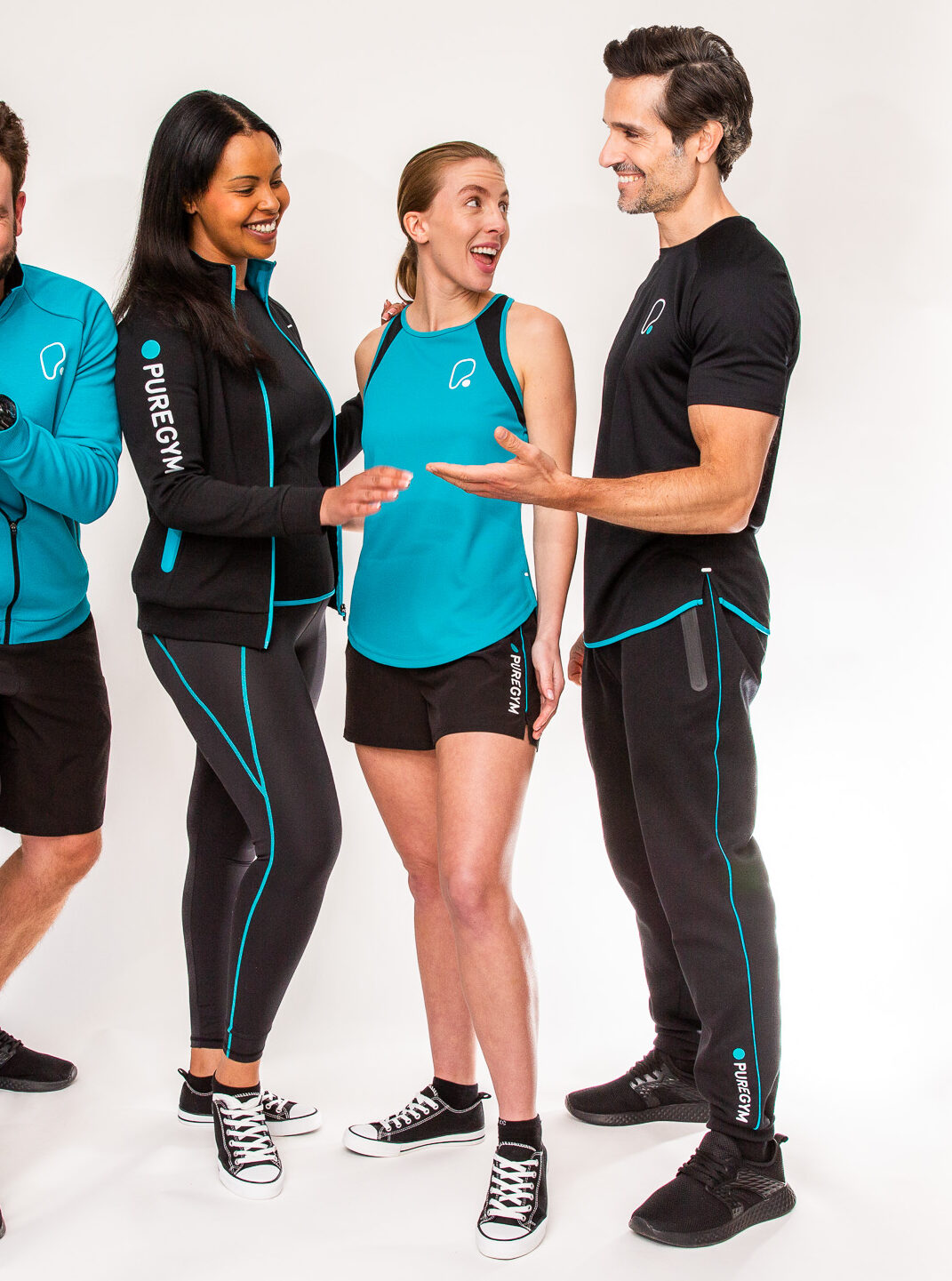
This is clearly demonstrated in our redesign of staff fitness wear for PureGym. Fit was identified as a primary concern from the outset, alongside the need to create a wardrobe that worked across multiple roles and the daily physical demands of a gym environment.
The project used avatar-based digital design tools to assess fit across body types before physical samples were produced, which maintained accuracy without requiring in-person fittings during a period of social distancing restrictions. The resulting range covered personal trainers, fitness coaches, management, and central support teams, ensuring everyone across the organisation felt included.
Moving from Uniforms to the Wardrobe Approach
This approach allows employees to choose items that suit their role and working conditions while maintaining a consistent brand identity. For businesses, it offers greater flexibility and improved wearer satisfaction.
The shift from a single gym uniform design to a coordinated wardrobe is one of the most operationally significant decisions a gym operator can make. A wardrobe is a set of approved garments designed to work together cohesively, in the operator’s colour palette and brand language. Staff can select items from this wardrobe that they deem appropriate to their role and their working conditions on any given day.
For a mid-size health club, a well-designed wardrobe might include: a stretch performance top for active roles, a polo shirt for reception and management, an outer layer for poolside or outdoor use, a base layer for colder conditions, and a defined colour distinction between public-facing fitness staff and operational or support roles. Members can then quickly identify who can help them on the gym floor, which directly supports service quality.
Case Study: David Lloyd Leisure
This approach can be seen in our workwear design for David Lloyd Leisure. The brief required a considered approach to gym uniform design that would support staff working across multiple functions, from the fitness floor to front-of-house environments, while maintaining a consistent and recognisable brand identity across 99 UK clubs and 15 European sites.
We developed a wardrobe built around flexibility and performance, incorporating the brand’s colour palette of black, white, and green. Hard-wearing stretch fabrics were incorporated into contemporary shapes that held their structure under intense physical demands whilst maintaining a professional appearance in customer-facing settings. The result was a uniform programme that performed effectively across David Lloyd Leisure locations, supporting both staff experience and member perception.
This programme also illustrates a point that often surprises leisure operators: a wardrobe of well-designed sustainable workwear frequently costs less over a three-to-five-year lifecycle than a lower-quality single uniform. This is due to the combination of improved fabric durability, higher wearer adoption, and reduced replacement frequency, which together outweigh the higher initial design investment.
Managing the Programme: Where Gym Uniforms Most Commonly Fail Operationally
The design phase of a gym uniform programme is often the most visible. However, it is in the operational management phase where problems typically arise. High staff turnover is a structural reality in the leisure sector, with frequent changes across roles and locations. Without a managed stock and reorder system, uniform consistency can quickly deteriorate.
Common failure points include stock shortages at busy sites, disorganised reordering due to a lack of central entitlement data, inconsistent garment batches, and limited visibility of overall inventory. These challenges can be addressed through RFID-enabled tracking, online ordering portals with defined role entitlements, and predictive stock modelling. This approach not only maintains consistency but also supports sustainable workwear goals by reducing over-ordering and waste.
For multi-site operators, accurate distribution to individual locations or regional hubs, supported by barcode checks, ensures long-term consistency. Effective programme management is not a minor detail; it is what allows a gym uniform design to retain its value over time.
What Procurement Teams Should Ask Before Selecting a Gym Uniform Supplier
The difference between a managed uniform programme and a garment reseller is not always obvious from a supplier’s marketing material. The following questions help gym procurement teams assess whether a gym uniform supplier can genuinely deliver a fit-for-purpose programme.
| Question | What a credible answer looks like | What a questionable answer looks like |
| How do you conduct wearer research for a new programme? | Structured interviews, role observation, and staged wearer trials. | Wearer research is unnecessary, a design proposal can be based on brand guidelines alone. |
| What sustainability credentials can you verify independently? | B Corp certification (verifiable via the B Lab directory), ISO 14001 certification, GRS-certified materials, Sedex membership, or EcoVadis rating. | None, only vague, self-declared “eco-friendly” claims. |
| What is your end-of-life approach for garments at the end of a programme? | A named recycling partner, take-back scheme, or closed-loop pathway. | Mentioning “responsible disposal”, but without any specifics. |
| How do you manage stock across multiple sites? | Online ordering portals with defined role entitlements, inventory tracking, and predictive stock modelling. | Stock is managed manually at site level (meaning no central visibility, tracking, or clear entitlement controls). |
| What is the realistic timeline for a bespoke programme? | 20 to 48 weeks, depending on scope. Shorter timelines may be possible for smaller or less complex programmes, but it is unlikely. | Anything under 20 weeks, as this will likely compromise the design or trial process. |
| What evidence do you have of inclusive design outcomes? | Named case studies where wearer engagement produced documented improvements in fit, adoption, or staff wellbeing. | None, just a general statement about sizing range. |
Operators reviewing responses to these questions against the full scope of their ESG commitments will quickly identify which suppliers are genuinely offering a lifecycle programme and which are offering garments with sustainability language attached.
JSD’s sustainability credentials include B Corp certification (as of March 2025, publicly listed on the B Lab directory), ISO 14001 environmental management certification, and EcoVadis Silver rating. These provide the independently verified governance that modern procurement teams increasingly require when selecting a custom uniform designer.
Frequently Asked Questions
Q: What fabrics are best for gym staff uniforms?
A: Performance fabrics such as recycled polyester blends are currently the most practical choice for gym uniforms, offering moisture-wicking performance, durability, and a credible sustainability story. Organic cotton and bamboo-blend fabrics can work well in lower-intensity roles such as reception or management.
Q: What makes a gym uniform “fit for purpose” rather than just functional?
A: A fit-for-purpose gym uniform serves the wearer’s role, reflects the operator’s brand, and holds up operationally across the full programme lifecycle. Functionality alone is the minimum baseline, but fit-for-purpose goes further, with role-specific garments designed around movement patterns, inclusive sizing that supports a diverse workforce, end-of-life recycling pathways, and stock management systems that prevent shortfalls during high-turnover periods.
Q: How long does a gym uniform programme take to design and deliver?
A: A bespoke gym uniform programme typically takes between 20 and 48 weeks from initial brief to rollout. Organisations that try to compress this timeline by skipping trials frequently encounter fit complaints, poor adoption, and early replacement costs, all of which cost more than the time saved.
Q: What sustainability credentials should a gym uniform supplier be able to evidence?
A: Credible sustainability credentials for a gym uniform supplier should include independently verified certifications and relevant independent frameworks rather than self-declared claims. Suppliers should also be able to describe their end-of-life approach, since Scope 3 emissions reporting increasingly requires this level of supply chain visibility.
Q: How do you design gym uniforms for a diverse workforce?
A: Designing gym uniforms for a diverse workforce starts with genuine wearer engagement that shapes design decisions. Generally, inclusive gym uniform design should include gender-neutral options, extended sizing, adaptive design for staff with different physical needs, and garments that accommodate religious or cultural requirements. The output should be a set of approved garments that staff can combine based on their individual needs.
Design a Gym Uniform Programme That Works as Hard as Your Team
A successful uniform programme is about supporting your people, strengthening your brand, and aligning with your wider ESG goals. Effective gym uniform design brings together performance, inclusivity, brand identity, verified sustainability, and long-term value, ensuring your team can operate confidently in every environment.
If your current gym uniforms are no longer meeting your needs, now is the time for a rethink. Partnering with a specialist gym uniform supplier allows you to create a consistent, high-performing, and responsible uniform programme that grows with your business.
At Jermyn Street Design, we deliver sustainable workwear solutions tailored to the realities of the fitness sector. We have created uniforms for leisure organisations including PureGym, David Lloyd Leisure, and Nuffield Health, managing every stage of the process, from initial concept through to rollout and ongoing programme support.
Speak to our team today to discover how we can support your organisation.
More Articles

How do sustainable uniforms influence employee retention and engagement?
Employee retention in large, customer-facing teams is shaped by daily experience more than policy statements. Pay, scheduling, leadership, and progression all matter, yet employees also assess whether their working environment has been designed with care. One of the most consistent signals in that assessment is the uniform they wear for most of their shift. Sustainable […]

What will procurement teams expect from an ethical uniform supplier in 2026?
In 2026, procurement teams are no longer persuaded by well-worded sustainability statements or high-level ethical commitments. They are looking for an ethical uniform partner who can evidence responsible practice across ethical workwear programmes with clarity, structure, and operational discipline, but also with a genuine understanding of the people who will ultimately wear the garments. The […]

JSD’s first year as a Certified B Corp: what that looks like in sustainable workwear
Certified B Corp since March 2025, JSD has spent the last 12 months learning what it means to carry that mark in day-to-day work. Not as a change in direction, and certainly not as a sudden awakening to sustainability, but as a way of sharpening and strengthening principles that have guided the business for years. […]

How Sustainable Uniforms Support Net Zero Goals in the Rail Industry
Sustainable uniforms reduce Scope 3 emissions by cutting the number of garments manufactured, shipped, and disposed of each year. A uniform that lasts three years instead of 18 months halves the manufacturing footprint for that item. Add controlled ordering to prevent surplus stock, take-back schemes to recover materials, and supplier data to track progress, and […]

Why Are European Businesses Updating Their Uniform Strategies for 2026?
Across Europe, uniform strategies are being reopened at board and procurement level for an unusual reason. Nothing is visibly broken, but confidence in the old approach has quietly eroded. For years, uniforms were specified on the assumption that stability would hold, climate patterns would remain predictable, regulation would move slowly, and sustainability expectations could be […]

How Are AI and Advanced Fabrics Transforming Sustainable Workwear Design?
AI and advanced fabrics are fundamentally reshaping how sustainable workwear is designed, specified, and produced. Digital prototyping eliminates wasteful sampling rounds. Predictive fit modelling ensures garments get worn rather than replaced prematurely. Evidence-based fabric selection replaces guesswork with data on durability and recyclability. For organisations managing large corporate uniform programmes, these innovations translate into reduced […]
